NO STORY IS AN ISLAND by Nirveda Alleck

Updated: Feb 11
Exhibition: 3 -23 Nov 2023 at Caudan Arts Center
On 23 January 2026, after my writing hiatus, I took an oath to revisit the past and acknowledge the beautiful shows that left me in awe. I consider my letters little archives that shelter the different nuances of my thoughts.
It's 22:47, my eyes half closed and fixed on the title: NO STORY IS AN ISLAND. These words together stirred me - then and now. I even visited the show twice, in early November 2023. It propelled me back in time, when I was prepping for my dissertation on colorism. So, I watched the show through that lens.
I can't wait to recall these fragments of stories - stories I learnt to digest. Parcels of history I first learnt theoretically and later witnessed.

50 Nuances of Black

A lot is happening in this painting. The skin color, the hair texture, and the gender. Both figures face the horizon, as if a brighter future were resting in the palm of their hands. Decades and centuries later, the shackles of the past left room for deeper, unhealed wounds passed on from one generation to the next.
The word colorism never reached my ears before. Our island, Mauritius, is rich in diversity where different religions and cultures cohabitate under one roof. However, discrimination still prevails in various forms. But I was never introduced to this term, colorism. I had to leap out of the Indian Ocean to zoom in on the Atlantic Ocean. I encountered the word through American history. The place where Africans were forcibly brought and the systems of racial slavery intensified over time.
Voyage à la Rivière des Roches

There's a woman who meets our gaze; the others, like the scene in the painting: Voyage entre deux temps, have their backs turned to us but facing la Rivière des Roches. A beautiful parallel that awakens thoughts. We can't see their facial expressions, and their voice can't be heard. It feels like a protest. We don't deserve their full story, only parts they allow us to see.
Clear Cut Contrast

When I entered the exhibition back then, I still remember how struck I was at the sight of this vivid blue. I'm not an artist, so I don't have the same flair for colors, but this blue spoke to me in different languages. Why the color blue? Why adorn the background in a uniform color? Did the artist, Nirveda Alleck, have a purpose in mind? Since I don't have the answers, I've knitted together a reason for the color blue.
Apart from being my favorite color, blue is usually synonymous with trust, loyalty, relaxation, and calm. It's in contrast with what the slaves endured: pain, humiliation, and inhumanity. Their life was far from being peaceful or serene. So, Nirveda Alleck might have added some lightness to a heavy history.
In the painting Transcendence, the blue contrasts with the woman dressed in yellow. She might be the owner of the land and slaves. Her other self is levitating. Is she dead? Barefoot, she's leaving this world. I've spent a few minutes watching that lady - her piercing gaze is stirring.
This wall feels heavy.

Looking back, this wall feels heavy in emotions, meanings and stories. There are so many layers to each painting. I'll try to articulate how they made me feel.

The yellow and blue elements are back, but this time set against a light grey background. I was curious why these two colors were the dominant characters. So, I scrolled on her Instagram feed to find the answer. To my surprise, blue prevails in her paintings. That's undeniably her artistic imprint.
L'Heritage is piled with meanings. In the background, silhouettes pop up, revealing a crystal clear segregation. To the left stands a man of authority - his demeanor and suit offer the clue. To the right, a group of men appears, their clothing suggests they could be indentured laborers rather than slaves. The colorful woman in the foreground appears to be light-skinned. Is she white? Or of mixed heritage? I think her feet give the answer. Her eyes are fixed on the group of men. I wish I could hear their conversations. Maybe it was just an exchange of glances and inaudible sounds.
The production of lighter-skinned children

The darker-skinned humans on the ground represent the enslaved majority. They are denied a seat at the table. Half naked bodies, babies crawling, the contrast is unmistakably portrayed with brutal clarity. It reflects the reality - then. The woman of mixed heritage was wrapped in blue and yellow fabric. She sits on the table comfortably, feeding a child who could be hers, facing the master, the white owner.
My choice for the title: "The Production of lighter-skinned children" might have shocked you, but it's a blatant truth. Under slavery, sexual violence by slave owners and overseers against enslaved women was common. This violence often resulted in the birth of lighter-skinned children. The children born usually had mixed ancestry - African and European or even Indian (post slavery indenture period).
As slaves' skin complexion began to change, so did their treatment. On the Island, the color hierarchy was influenced by their ancestry, skills, language, and more. Some mixed-heritage children were sometimes given preferential treatment because they were informally related to the slave owners. They mostly worked indoors - sewing, mending, childcare, and cooking. On the other hand, dark-skinned slaves worked outdoors in the fields.
In Life of Plantation Field Hands, James Stirling describes how slavery subjected all enslaved people to oppression, while treatment varied depending on labor roles and circumstances. Mauritius history might differ from the US, but the logic of hierarchy can't be swept under the rug.

A succession of letters forming words: noir, blanc, noir sur blanc, nègres...White text on a black canvas mirrors this emphasis on black and white skin color.
This letter felt incomplete without acknowledging how the indentured laborers shuffled the population structure in Mauritius. A complex racial hierarchy was born - one where formerly enslaved Africans, mixed-heritage groups, Indo-Mauritian Labourers, and Franco-Mauritians learned to live next to each other.
This newly formed neighbourhood reshaped colorism. However, lighter-skinned communities were regarded with respect, while the dark-skinned individuals were marginalised.
Formability of thoughts

I love this piece of art. It's not a painting. It's a chair, placed here, so we could sit and ponder on history. So, I took this chair, carried it with me in my thoughts, and after a few years, I was finally ready to sit down and navigate the branches of reflection that echoed back to me.
It's not an easy thing for me to think out loud and share these glimpses of reflection. It demands a sense of vulnerability. An art show can strike me at first, but it's only a few years after that the words flow through.

220 Years
The red chair is back, indeed; it was there all along. From the Transcends to the Formability of Thoughts, and now the 220 Years painting. The blue background is also back. Only the yellow color is missing.
In this painting, there are two chairs. After the old lady, it's a young-looking guy who's levitating. I love the parallels interweaving each piece of art. There's an invisible thread connecting this show. Nirveda Alleck knows how to stir curiosity in an audience. I'm part of this audience and am here for it.
I would like you to take a minute or two to scrutinize the blue background. How beautiful are the details peeking behind. It was done surgically!
Au Bas des Trois Mamelles

Au bas des Trois Mamelles, the slaves were living, and hiding.
I never knew that back in history, the Trois Mamelles mountain was one of the hiding places of the "maroons." The same place where I went hiking and had fun last year was a refuge for slaves. I've been walking with hiking shoes on the same grounds they walked barefoot. I'm trying to picture how they felt and lived. They hid from colonial authorities. Tried to survive by hunting and searching for plants. They lived with the sharp sword of Damocles hanging over their heads.
The Trois Mamelles is a symbol of courage and resistance.
Heart on Leaves

I can see a patched-up heart, and for me, it represents the thousands of hearts that sought freedom and peace. Their hearts bled for survival. Their daily life was punctuated by chaos. They were exiles on an island we call Paradise. This patched heart, resting on this green pasture, sounds like freedom. Now, they float in the clouds.

In her Garden
Backless women, draped in pink guarded by three dogs.
This garden feels like Eden. This idea got crayoned in my mind. A place of pure innocence not yet stained by fear, shame, or moral conflict. It was a life of pure bliss with God. This painting feels like it mirrors another reality far from the ruthless life many led.
Is it one lady in HER garden? I don't quite understand, but that's the beauty of art. We can try to understand, but we might never be close enough.
The purpose beneath this canvas belongs to the artist, Nirveda Alleck, but the imagination is twisted in my memories.

Under the Sun

Under the sun, the garden got its color palette back. No more electric blue dressing the canvas. The leaves, flowers, cat, and human wear the colors of daily life. It feels like the sun represents the time after slavery. The Island is blooming, away from a regime of repression, violence, and inhumanity.
That girl hiding behind an African-inspired ancestral mask can be a bow to the Island's history and inherited identity. The cat doesn't miss a thing - completely awestruck.

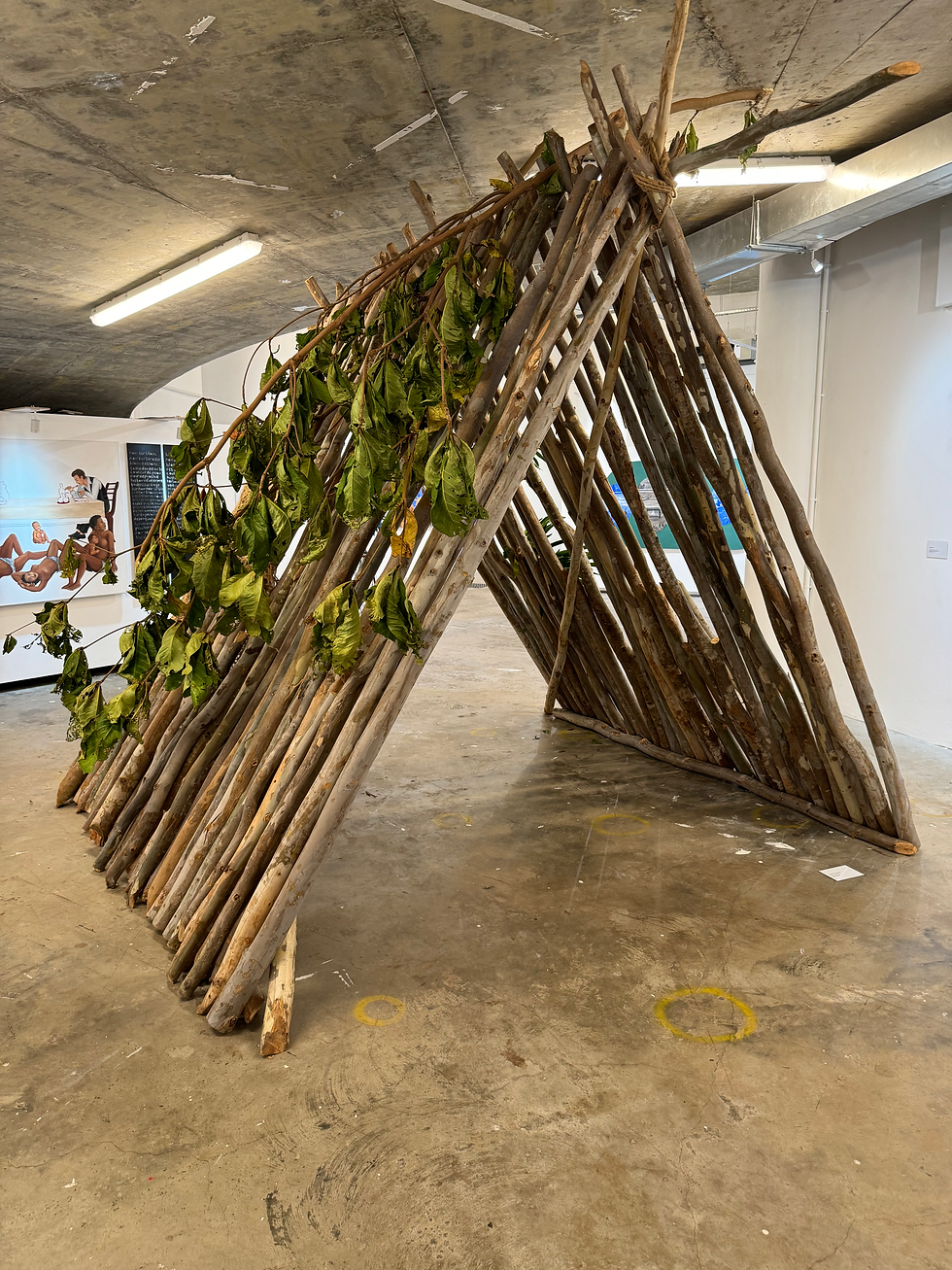
Where it all began...

Time-travelling might be a fiction in books and movies, but I hope my letter served as a time machine. Bringing you back to a reality that suffocated thousands of beings. Nirveda Alleck navigated slavery with poise. Each piece was a beautiful testament to our island's heritage. A part of history that bleeds in our veins. Going back in time to revel in art is an escapism - one rooted in reality.
An art exhibition like this one ages like wine. It tastes even better as we grow with it.
This essay reflects my personal interpretation.


soi cầu xsmb mình thấy bạn bè nhắc suốt nên hôm trước rảnh mới ghé thử cho biết. Mình không đọc kỹ nội dung đâu, chủ yếu xem giao diện có dễ nhìn không thôi. Vừa vào là thấy trang làm khá gọn, kiểu chia từng khối nội dung rõ ràng nên mắt mình bắt thông tin nhanh, không bị “ngợp” chữ. Mấy bảng số liệu họ canh theo cột nhìn thẳng hàng, kéo xuống lướt phát là hiểu đang ở đoạn nào. Cái mình thích nữa là menu để ngay chỗ dễ thấy, bấm qua lại mấy mục không phải tìm vòng vòng. Nói chung cảm giác thân thiện kiểu ai mới vào cũng không bị lạc, nhất là…